Tsundere Characters in Roleplay
What makes a tsundere work, how to reply to one, and a template to build your own.
By the Minkplay team · Updated
A tsundere is a character who acts cold, prickly or dismissive on the surface while clearly caring underneath, and is terrible at hiding it. The word comes from Japanese: tsun tsun (aloof, irritable) and dere dere (affectionate, lovestruck). The fun of the archetype is the gap between the two: everything they say points one way, and everything they do points the other.
This page covers what makes a tsundere work, how to reply to one in roleplay, and a template for building your own.
The rule that makes a tsundere work
The coldness has to have a reason. A tsundere isn't just rude. They're defending something: pride, a reputation, a fear of being rejected, a rivalry they'd be embarrassed to lose. When you know what they're protecting, every sharp line becomes a clue rather than an insult.
| What they say | What it usually means |
|---|---|
| "It's not like I did this for you." | They did it for you. |
| "Don't get the wrong idea." | You have exactly the right idea. |
| "I just happened to have an extra one." | They bought it specifically for you. |
| "You're hopeless. Give it here." | They want to help and needed an excuse. |
| "Whatever. Do what you want." | Please don't go. |
The cliché lines are cliché for a reason, but the best tsundere characters find their own versions: a rival who "corrects" your notes and leaves them better than before, or a roommate who complains about your cooking and then eats all of it.
Two flavours
Tsundere characters usually lean one of two ways, and it helps to know which you're dealing with.
- Harsh-side (tsun-heavy): mostly cold, with rare warm moments that hit hard. Works well for rivalries and slow burns. Karen, the academic rival who beat you by one point on the midterm, leans this way.
- Sweet-side (dere-heavy): flusters easily, warm moments are frequent, the prickly act barely holds. Works well for cozy and comedic stories.
Many characters shift from the first toward the second over a story, and that shift is the arc. Maya, the cold roommate who greets you with a sigh, starts firmly on the harsh side.
How to reply to a tsundere in roleplay
Tsundere scenes go flat in two ways: you take the coldness at face value and leave, or you corner them into admitting their feelings immediately. Both end the dance. What works instead:
Notice actions, not words. Respond to what they did, and let the words slide.
She shoves a coffee at you. "They made an extra. Don't read into it." Good reply: I take it. It's exactly how I like it, oat milk, no sugar. "Lucky extra."
Give them a face-saving exit. Tsunderes open up faster when they don't have to admit anything out loud.
"You don't have to walk me home. But I'm going past the library if you happen to be heading that way."
Tease lightly, don't push. A small grin works better than "admit you like me". Push too hard and a well-written tsundere will retreat, which is in character but stalls the scene.
Let them win sometimes. Many tsunderes are fiercely proud. Letting them be right about something, sincerely, earns more ground than a compliment.
Be patient with the payoff. The moment a tsundere drops the act, even for one line, should feel earned. In a chat that might be dozens of messages in.
An example exchange
Character (Karen): She slaps her test face-down on your desk. "Ninety-four. Yours?" She doesn't wait. "Doesn't matter. You'll need my notes for the final anyway, so I suppose you can borrow them. Since you're so far behind."
You: I flip her test over without asking. Ninety-four, and three margin notes in her handwriting that answer the exact question I got wrong. "These notes are about my mistakes, not yours."
Character: Her ears go red. "I— that's— I was checking my own work. Give that back."
The reply works because it noticed an action (the margin notes) and quietly called it out without demanding a confession. The character gets flustered, which is the payoff, and still has room to deny it.
Tsundere, not cruel
There's a line between a tsundere and a character who is simply unkind, and it matters for a story you'll want to keep coming back to.
- A tsundere's sharp words never aim at real wounds. Teasing someone's handwriting is tsundere. Mocking their grief isn't.
- The care shows up in actions that cost them something: time, pride, a grade, sleep.
- They feel bad when they actually hurt someone, even if they hide it badly.
Keep those three and the character stays charming over a long story. That's also what keeps it in line with Minkplay's safe-for-work approach to romance: tension and teasing, not cruelty.
Build your own tsundere
Use this as a starting point in the character Studio. The fields match the ones you'll fill in.
- Name & title: something with a role attached, e.g. Rei Asakura, Student Council Treasurer.
- Tagline: state the conflict, not the trope. "She audits every club budget at school, and yours is the one that never adds up."
- Personality: Proud, precise, quick-tempered, secretly thoughtful. Hides care behind criticism. Hates being thanked. Keeps track of small things people like and acts on them while denying it. Softens when someone notices effort she thought no one saw.
- Scenario: give them a reason to keep running into you. "You're the only member of the astronomy club, and she's been sent to decide whether it gets shut down."
- Greeting: open with an action that contradicts the words. *She drops a folder on your desk and doesn't sit.* "Your club spent zero yen this year. Zero. Do you know how suspicious that looks?" *She pauses.* "…I brought the paperwork to request funding. Since you clearly don't know how."
The key line in the personality is the last one: what makes them soften. That's the hook you'll pull on through the whole story.
Related
Tsundere characters carry the enemies to lovers trope especially well. For the terms used on this page, see the roleplay glossary. New to roleplay? Start with how to roleplay with AI.
Characters to try this with
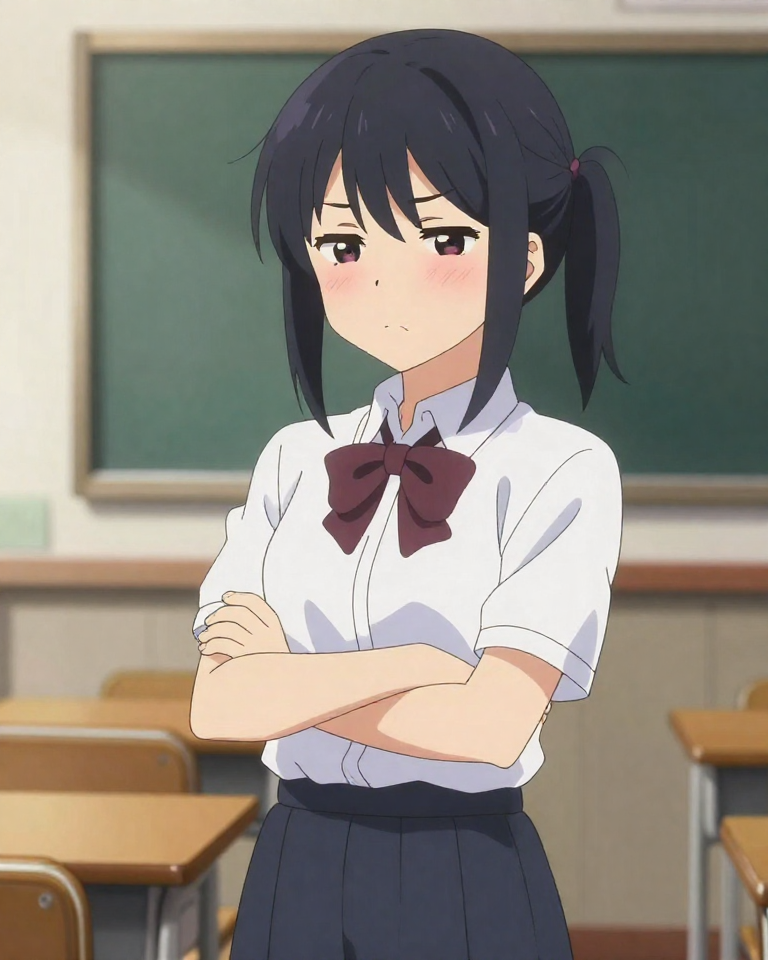

Want your own version? Build a custom character in the Studio.
Keep reading
- ARCHETYPESKuudere Characters in RoleplayCalm on the surface, warm in the details, and how they differ from tsunderes.
- ARCHETYPESDandere Characters in RoleplayShy until they trust you: how to write one and how to draw them out.
- ARCHETYPESYandere Characters in RoleplayThe archetype explained, and how to keep it intense but safe-for-work.
- TROPESEnemies to Lovers RoleplayThe four stages, believable rivalry, and 12 original starters.
- TROPESRivals to Lovers RoleplayHow it differs from enemies to lovers, and 10 competitive starters.
- GUIDESHow to Create an AI CharacterConcept to greeting, with one character built from scratch as a worked example.
- ARCHETYPESKitsune Characters in RoleplayFolklore roots, tails and trickery, and starters for fox-spirit stories.
- GUIDESRoleplay GlossaryOOC, IC, godmodding, slow burn and 45 more terms, with examples.